
A first call with a fragrance factory is a scoping conversation, not a pitch meeting. What you get out of it is proportional to what you bring: a product definition, a scent direction, a volume outlook, destination markets and a view on packaging. Bring those and the call ends with a scope, a sample path and a named next step. Bring a general idea and it ends with a brochure and an invitation to send more information.
Key takeaways
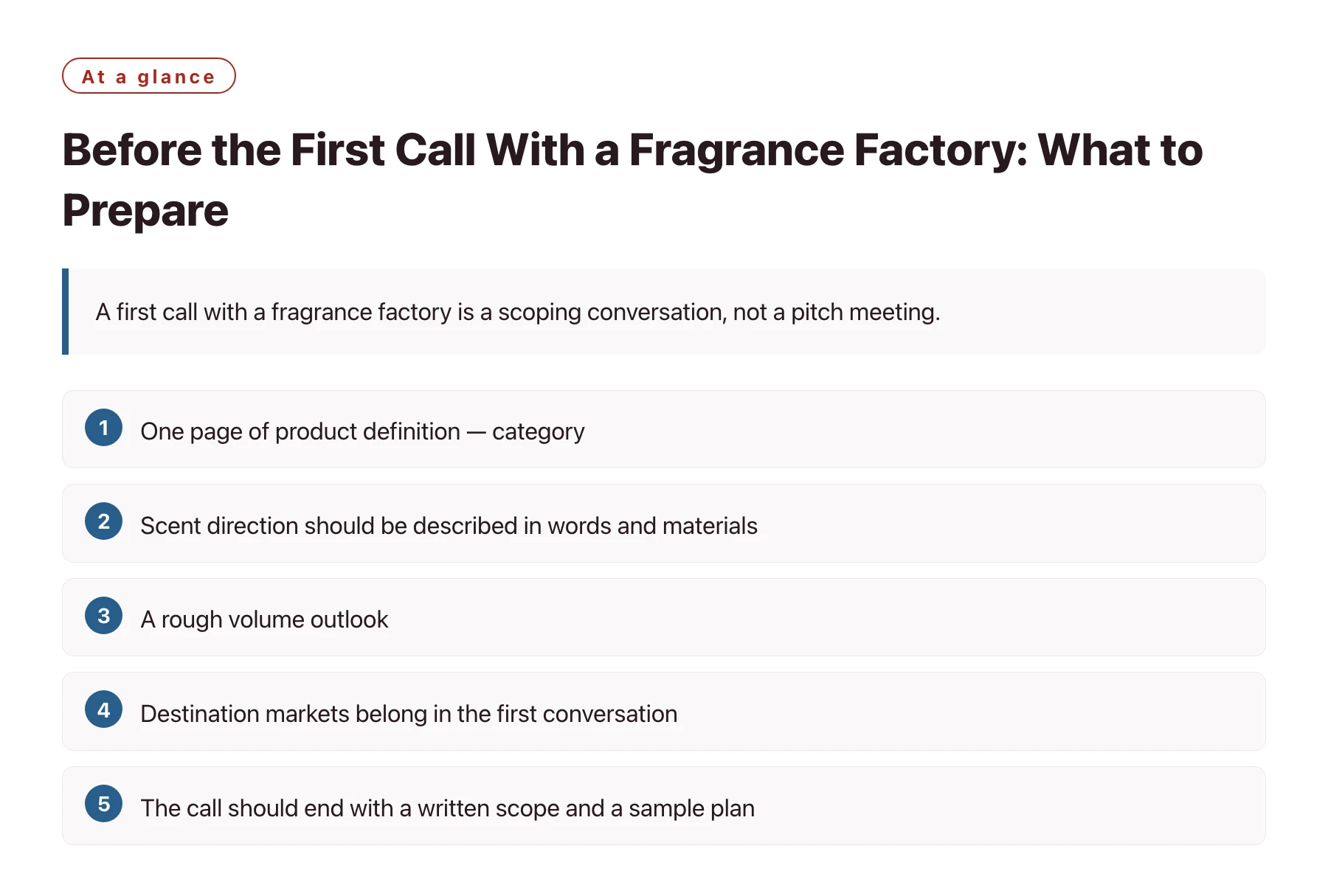
- One page of product definition — category, format, fill, pieces per set and target retail price — does more for the call than any presentation.
- Scent direction should be described in words and materials, because naming other brands' products gives a factory very little to work with.
- A rough volume outlook, even a wide range, is what allows a supplier to say whether your set is a standard job or a special case.
- Destination markets belong in the first conversation, because they change labelling, documentation and sometimes the formula itself.
- The call should end with a written scope and a sample plan, not with a price quoted from memory.
Product managers often prepare for a factory call by researching the supplier. That is the smaller half of the work. The larger half is preparing the product, because a factory can only respond to what it can measure.
This article lists the material to have ready before the call, why each item changes the conversation, and how to run the call so that it produces a scope rather than an impression.
The preparation pack
| Item to prepare | Why the factory needs it | What happens without it |
|---|---|---|
| One-page product definition | Sets the category, format, fill levels, pieces per set and target retail price | The call becomes a tour of the supplier's capabilities instead of a scoping exercise |
| Scent direction in words | Gives a perfumer something to build from: families, materials, mood, intensity | Feedback arrives as a series of rejections without a direction to converge on |
| Reference products described honestly | Shows the market position you are aiming at, without copying a specific product | The supplier guesses at the wrong price tier and samples for the wrong segment |
| Volume outlook for the first year | Determines which components and processes are realistic, and how the order is priced | Any comparison between suppliers is guesswork, because volume drives everything |
| Destination markets and claims | Fixes labelling, documentation and the standards the formula must meet | A compliant formula for one market is proposed for a market it does not suit |
| Packaging status and assets | Tells the factory whether it supplies the pack, fills yours, or decorates existing models | Quotes include components you already have, or omit components nobody ordered |
| Your decision authority and deadline | Lets the supplier plan sample rounds and production slots realistically | Timelines are promised that nobody on your side can approve in time |
None of these items has to be final. A draft product definition and a rough volume range are far more useful on a first call than silence on both.
Why scent direction is the hardest item to prepare
Buyers usually prepare scent references by naming products they like. That tells a perfumer almost nothing usable, because a finished product is a compound of many decisions and copying it is both difficult and commercially unwise. Describing what you actually respond to is more productive: is the opening bright or warm, is the heart floral or woody, is the dry-down clean or resinous, how strong should it be on the skin or in the room?
Material vocabulary helps even at a basic level. Saying that you want the freshness of bergamot rather than the sweetness of a fruit accord, or a dry cedar base rather than a sweet musk, narrows the search space immediately. Teams that invest in this vocabulary make better use of a factory's development time, and structured courses exist for exactly that reason.
It also helps to state what you do not want. Exclusions are cheap to give and save a sample round: no heavy sweetness, no strong patchouli, nothing that reads as an air freshener.
Running the call so it produces a scope
- Confirm the scope out loudWalk through who supplies the scent, the pack, the presentation packaging and the documentation. Have the supplier repeat it back before moving on.
- Test the model fitAsk whether your set is closer to OEM or ODM work in their experience, and what changes in price and timeline when you move a workstream from one side to the other.
- Agree the sample pathDecide how many directions will be sampled, in which format, on what schedule, and what counts as a revision rather than a new direction.
- Ask the compliance questionsMaterials are restricted according to how a finished product is used, so ask which standards apply to your specific format and market, and who evidences it [1].
- Close with written next stepsAsk for a written scope, an exclusions list and a sample plan by an agreed date. A verbal price is not a quotation.
Questions worth asking a factory about itself
The call is also your chance to qualify the supplier. Where does the work actually happen — development, filling, decoration, packing? Which parts are outsourced, and how are they controlled? What does the factory do when an incoming component does not match the specification? Who signs off a batch, and what records exist if a customer complaint arrives two years later?
Industry associations publish guidance on how fragrance businesses operate and what responsible practice looks like, which is a useful benchmark when you are hearing these answers for the first time [2]. Ten minutes of preparation on the supplier's own site, whether it is a specialist workshop or a house such as the company behind the factory, also gives you something concrete to test: the claims on the page should match the answers in the call.
Finally, ask what the factory wishes clients prepared better. The answer is usually the same three things: a clearer volume range, a faster approval route on their side, and one person who can make a decision.
If a supplier can explain what custom fragrance R&D and production includes, what it excludes and what you must bring, you are talking to the right part of the business. Everything else — prices, dates, samples — only makes sense after that. The public starting point is xuelei.com.
Sources
- IFRA Standards Library (International Fragrance Association) —— The IFRA Standards Library lists the restrictions the fragrance industry applies to individual fragrance ingredients, based on safety assessments; it is the reference point for compliant fragrance formulation.
- Cosmetics Europe —— The European trade association for the cosmetics and personal care industry, publishing guidance, positions and market information.
Frequently asked questions
How long should a first supplier call be?
Thirty to forty-five minutes is enough if you have prepared the product definition and the volume range. Longer calls tend to be longer because the preparation was thinner.
Should I ask for a price on the first call?
Ask for a price range and the drivers behind it rather than a number. A firm price requires a defined scope, and that is the output of the call rather than an input.
What if I do not know my volumes yet?
Give a range and say what it depends on. A supplier can work with a range; it cannot work with an unknown, and the components and processes it proposes will be guesses.
Do I need packaging designs before the call?
No, but you should know the status: already designed, being designed, or to be sourced. That single answer changes which model the supplier proposes.
How many suppliers should I brief at once?
Two or three is usually manageable and enough to compare. Briefing many suppliers with the same document costs time on your side and produces quotes that are hard to compare meaningfully.